
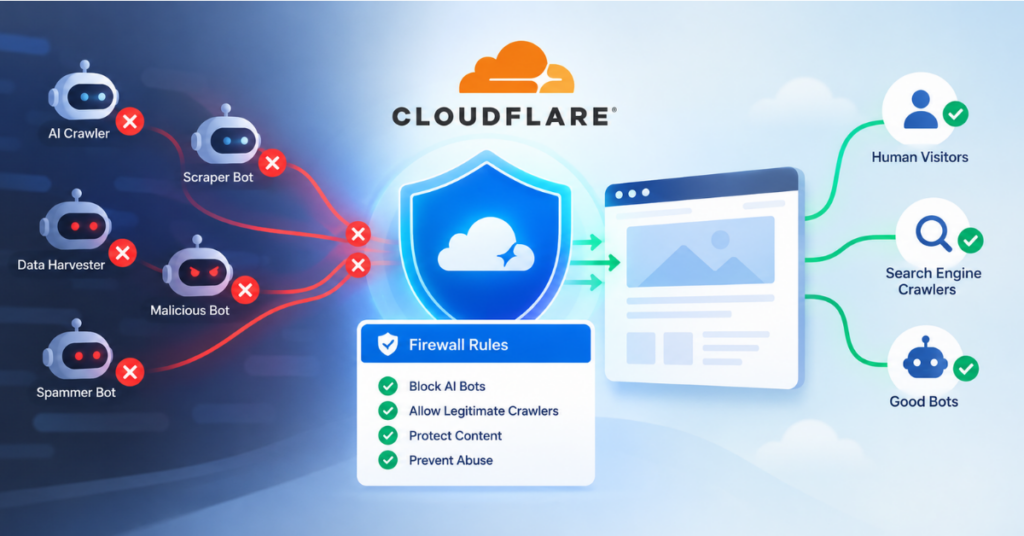
Today, websites are not just visited by humans and search engines. There are increasing numbers of requests from AI training crawlers, answer-engine fetchers, scrapers, and automated attack tools. Some of these bots are useful, some are neutral, and some are harmful. Cloudflare provides the site owners with a set of tools to identify and determine what each of them can do.
This article discusses the main rule types and a reasonable way to set them up.
Understand the Types of Bots
You can classify traffic that is automated. Search crawlers such as Googlebot and Bingbot provide visibility. AI crawlers gather content to train a model or to provide live answers. Their value depends on your goals. Scrapers copy content or prices without authorization. Malicious bots try credential stuffing, form spam and vulnerability scans. Different groups need different responses.
Cloudflare’s management features
Cloudflare offers bot scoring, verified bot lists, and managed rules. Verified bots are known, legitimate services, so you can allow them, while challenging unverified traffic claiming the same name. Cloudflare also has a one-click setting on many of its plans to block or manage AI crawlers, which is a quick starting point.
A digital marketing agency focused on growth can help you figure out which AI Bots you might want to allow. Blocking them all could decrease your chances of showing up in AI answers and allowing them all could expose premium content.
Creating Useful Custom Rules
You can write rules in the Web Application Firewall with fields like user agent, IP range, country, ASN and request path. Some useful patterns here.
- Requests that are challenging with empty or suspicious user agents.
- Throttled login, search and checkout endpoints by IP.
- Block known bad ASNs generating scraping or attack traffic
- Allow search by verified bots but put stricter limits on unverified bots using the same name.
- Protect admin paths like wp-admin with an additional challenge or IP allowlist.
Marketers and developers working together produce better results. A digital marketing agency in Indore needs to know what pages are generating leads so that firewall rules never hinder landing pages, forms or tracking tags.
Don’t Rely on User Agents Alone
It is easy to fake user agent strings. Mix them with reverse DNS checks, IP verification, and Cloudflare bot scores. Compare with the official IP ranges published by a company for its crawler. This prevents impostors pretending to be a trusted bot from slipping through.
Ask any SEO company in Indore how they test bot rules prior to the launch. A careful process includes staging checks, a log-only trial period and a rollback plan in case a rule blocks something important.
Watch before you block.
Start new rules in log or managed challenge mode. Monitor analytics for a week. Make sure real customers, payment gateways, and legitimate search bots are not caught. Make the rule block and check it’s right. Check back every quarter. Bot behavior keeps changing.
Security and SEO – A Partnership
Too much blocking can hurt your search visibility, and too little blocking can hurt performance and security. It’s deliberate, tested rules that balance the. Working with an SEO company in Indore that also understands server-level controls mean your protection layer never inadvertently shuts out the crawlers you want.
Tags:
Founder of Neha SEO Solutions, Indore. Neha has handled SEO and digital marketing projects for clients across India, the USA, UK, Canada, Australia and New Zealand.
About Neha SEO Solutions →